Wellbeing in the Digital Era
International Workshop


Harmonious beauty has been forbidden in artworks after Adorno's philosophy of art has become culturally dominant in the second half of the twentieth century. However, some posthuman artworks have developed new concepts of beauty, while many posthuman artworks have also moved beyond this cultural prohibition. Does it mean that these works of art are aesthetically without relevance, that they are merely creations from the cultural industry to promote their capitalist interests, and that they affirm totalitarian ethical structures? Many artists of the posthuman have to face this criticism, which applies to the bioartist Eduardo Kac in the same way as to composers like Philip Glass or Sven Helbig. Contrary to the judgement of the intellectual avantgarde tradition inspired by Adorno, I will highlight the cultural relevance of beautiful artworks after the posthuman paradigm shift. Thereby, I will address the following issues: What is the posthuman paradigm shift? What are the implications of the posthuman paradigm-shift for works of art? What is the meaning of beauty in posthuman works of art? What is the connection between beauty and health? Why is health important?
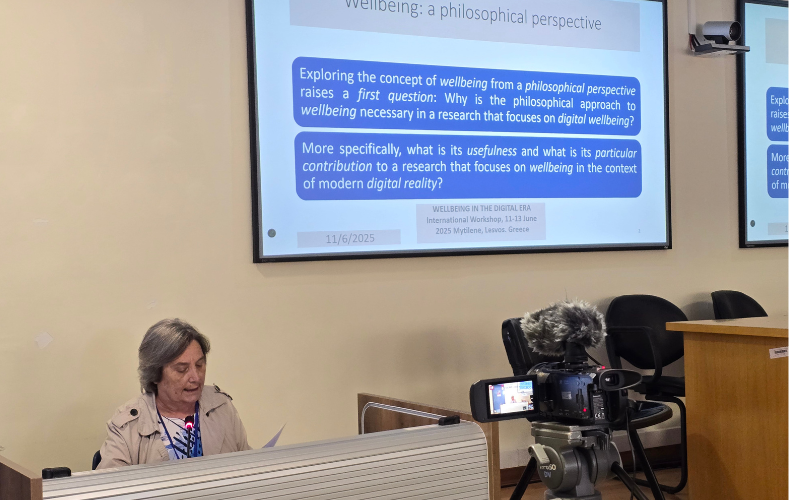
The aim of this work is to examine the notion of wellbeing from a philosophical perspective and, in particular, to explore its origins and its development in the texts of ancient Greek philosophers. The main question that arises is why the philosophical approach to wellbeing is necessary in a research that focuses on digital wellbeing. The answer to this question is revealed as significant for this research, since in the age of digital technology the non-anthropocentric care of the self in ancient Greek philosophy can offer a new meaning to technology, that of a shift from its instrumental use that inevitably leads to technocratic and transhumanistic perceptions, to its posthuman dimension, that is the interweaving of human and technology.
Additionally, the aim of this work is to examine the notion of wellbeing from a philosophical perspective and, in particular, to explore the inclusive dimension of nature in ancient Greek philosophy. In this respect, relevant texts will be explored, which highlight the continuity and the kinship of humans with all living beings within a context of a non-anthropocentric perception of wellbeing. In the light of a research that focuses to digital wellbeing we considered as important to explore the relation of human with the other side of the non-human. This research, allows us to claim that ancient Greek philosophy can offer a multitude of new meanings to digital wellbeing of nowadays, in the direction of interweaving of human and technology, so that to construct a posthuman self.
This paper explores how Avatar: The Way of Water (2022) interprets well-being from a Posthuman and semiotic perspective. While Posthuman philosophy has thoroughly studied embodiment, ecology, and technology, the concept of well-being has gotten little attention in this discussion. Drawing on semiotic frameworks such as Yuri Lotman's semiosphere and Roman Jakobson's transmutation, the study uses qualitative semiotic analysis to look into how the film translates philosophical conceptions of interdependence and vitality into cinematic form. Avatar's visual and emotional language depicts well-being as a distributed process that covers species, bodies, and media, rather than an individual trait. The chapter concludes that popular culture serves as a platform for philosophical and ethical problems about life, care, and sustainability, establishing Avatar as a critical cultural text for understanding well-being in the Posthuman period.
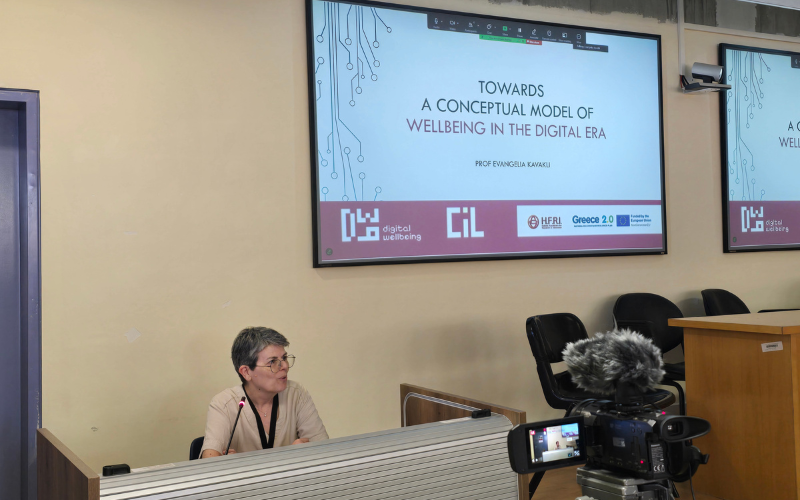
This paper critically examines the conceptual evolution of Digital Wellbeing (DWB) from its early metaphorical reference to a salutogenic orientation toward its dominant framing within risk-oriented and regulatory discourses. We argue that contemporary approaches to DWB remain grounded in persistent dualisms between human and technology, real and virtual, and use and design, as well as in the myth of technological neutrality. Drawing on critical theory of technology and on relational, posthumanist, and new materialist ontologies, the paper challenges these assumptions and reconceptualises digital wellbeing as a relational phenomenon emerging within sociomaterial assemblages, rather than as an individual psychological state or a matter of correct use.
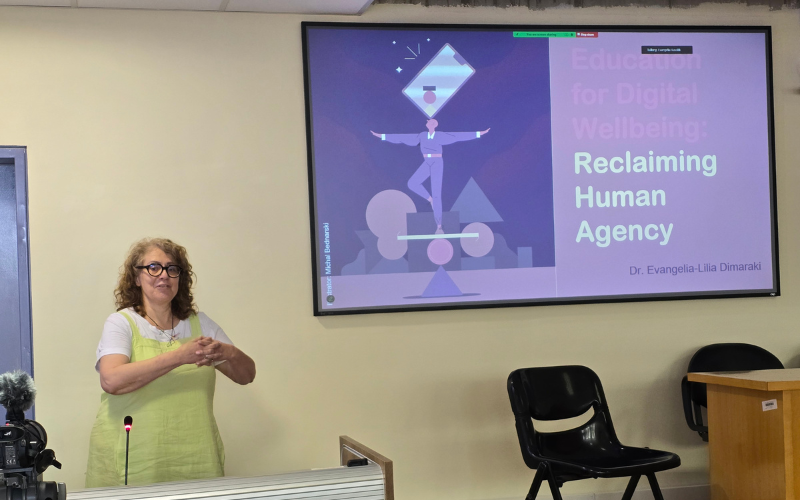
We experience the present configuration of digital technology as a boundless, algorithmically curated environment to inhabit. Can we thrive in this digital habitat, individually and collectively? The concept of digital wellbeing arises from a growing unease at technological developments misaligned with human thriving. Examples of misalignment consequential for education are distraction-by-design that fragments attention and the digital automation of cognition that trivialises mastery of knowledge and competence. I propose that education is the prime field for reclaiming human agency over technology. Two starting points for educators are cultivating students' agency over digital life and exercising their own agency over EdTech.